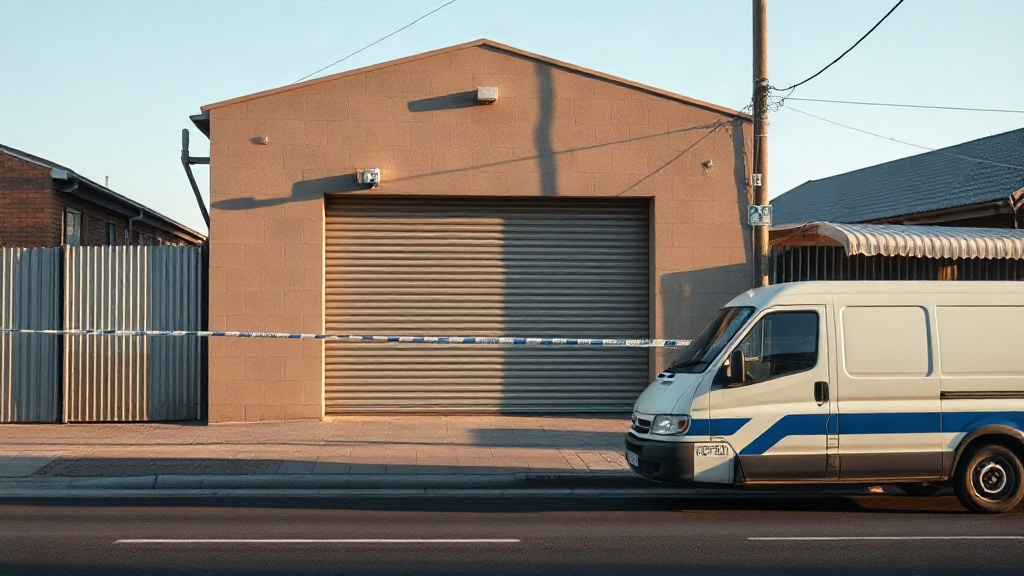
Durban asylum centre protest: what SABC reported, and what it left out
A group demanded that the Department of Home Affairs' Refugee Reception Centre stop processing asylum applications, and the report that carried the demand left the state's answer, the law and the numbers out.
A group of South Africans gathered outside the Department of Home Affairs’ Refugee Reception Centre in Durban on 7 October 2026 and demanded that the facility stop processing asylum applications entirely.
That is what SABC News reported, accurately, in a short item published that day under the headline “Disgruntled South Africans protest, demand halt to asylum processing in Durban”. The broadcaster described tensions as high outside the centre. We are not correcting that account. The protest happened, the demand was made, and the report said so.
What the item did not carry is the part a South African reader needs to make sense of the scene: what the centre is, what the demand would actually do if it were granted, what the law says about who may enforce immigration control, and what the department says in response.
What the centre does, and who is in it
The Refugee Reception Centre is the Home Affairs facility where people who arrive in South Africa and intend to claim asylum are received, interviewed and issued with the documentation that allows them to remain lawfully while their claims are processed. It is the front door of a system established under the Refugees Act, and it is the only lawful route by which a person arriving at the coast can regularise their presence here.
The demand reported by SABC was not for tighter vetting or faster processing. It was for a halt to all asylum application processing at the facility. If that demand were granted, the practical effect would be that people presenting themselves to the state to be documented would instead be turned away undocumented. That is a consequence the report did not spell out, and it is the consequence an ordinary Durban resident would notice first.
Who may enforce immigration law
No group, movement or individual may enforce immigration law in South Africa. That authority belongs to the state alone, exercised through the Department of Home Affairs, the South African Police Service and the courts. A protest outside a government facility is lawful. A blockade that prevents a person from reaching a counter, or that stops an official from doing the work the Act requires, is not. Intimidation, obstruction of access and any interference with the lawful business of a government office are offences, and the police are empowered to act against them.
That distinction matters, and it was absent from the report. The broadcast recorded a demand to stop a statutory function. It did not record that the demand, if acted upon by anyone other than the department itself, would be unlawful.
What the department says
The Enquirer put the protest and the demand to the Department of Home Affairs for its response.
The department’s position is that asylum processing at the Durban centre continues in terms of the Refugees Act, that the determination of who may remain in South Africa is a function of the state and not of any gathering outside its offices, and that members of the public who have concerns about immigration are entitled to raise them through the department, through Parliament and through their elected representatives rather than at the gate of a facility processing statutory claims.
The department has not said that the protest halted processing, and no evidence has been presented that it did. The centre’s operations are a matter of public record, and the lawful processing of claims at that facility is the state doing the job the law assigns it.
The context the broadcast left out
SABC’s item ran to a summary and a link. It carried no figure for how many people were at the protest, no statement from the department, no explanation of what the Refugee Reception Centre does, and no reference to the law that governs it. Those are omissions rather than errors. The report was accurate about what it saw.
But a South African watching that item would not have learned that the demand, if granted, would leave people in the country without documentation rather than remove them from it. They would not have learned that the enforcement of immigration law is reserved to the state. And they would not have heard the department’s answer to the demand made at its own gate.
The Enquirer has asked the Department of Home Affairs for the current number of asylum applications pending at the Durban centre, the number processed in the past twelve months, and any change to the centre’s operating arrangements following the protest. We have also asked the South African Police Service whether any arrests were made or cases opened in connection with the gathering on 7 October. Those answers will be published when they are received.
Source: SABC News, Disgruntled South Africans protest, demand halt to asylum processing in Durban
- Malema tells Kokstad rally Mtolo's grip on the municipality ends on 4 November 2026-10-05
- Jacinta Ngobese-Zuma lays charges over rape and murder threats as ANC calls for probe 2026-10-07
- Protesters picket Durban refugee centre as Home Affairs faces fresh asylum pressure 2026-10-07
- Zuma admitted to KZN hospital after Msinga event 2026-10-07
- Court ruling reopens asylum doors as Durban centre blocked 2026-10-08
- Durban refugee centre shut after violent protest halts asylum processing 2026-10-08
- Ten cars torched in Soweto and 11 in Durban as unrest flares, police move foreign nationals to safety 2026-10-08
- Sixteen vehicles burnt in Durban and Soweto as migration anger spills onto the streets 2026-10-08
- Court ruling on asylum does not create new rights, minister says as Durban centre blockaded 2026-10-08
- Cars torched in Durban as March and March protests spread to five cities 2026-10-09