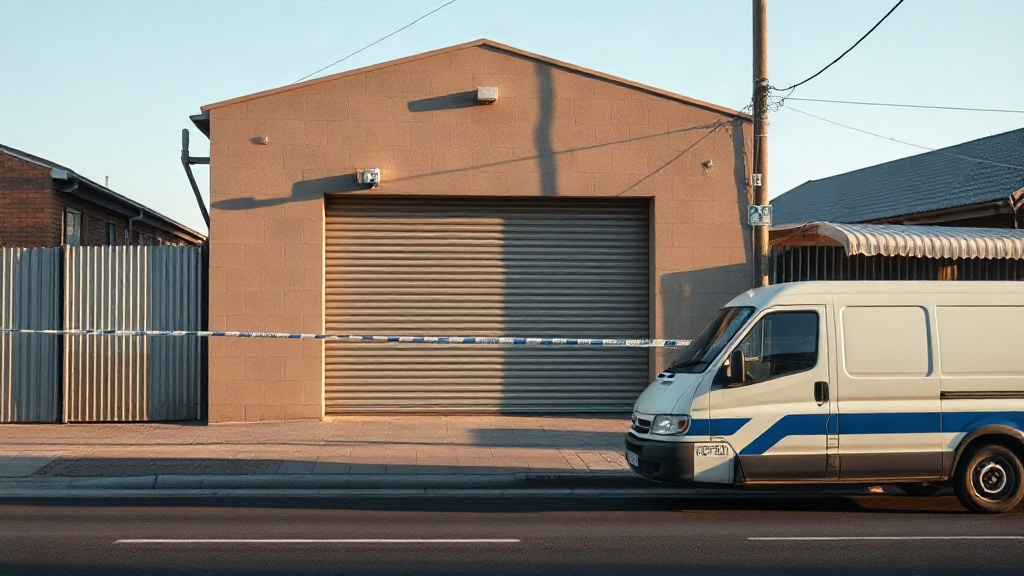
Eleven killed at a Durban house party, and the story a foreign report could not finish
Al Jazeera reported the shooting accurately and briefly. What a South African reader needs is the part that comes after the headline: who investigates, what the law says, and what the country does about illegal firearms.
Armed men opened fire at a house party in a Durban township, killing a pregnant woman and ten other people. Al Jazeera English reported the attack on 23 September 2026 under the headline that at least 11 people were killed. That summary is accurate as far as it goes, and this paper has no quarrel with it.
What follows is the part a South African reader already knows and a foreign reader does not. This is not a correction. It is the rest of the story.
A mass shooting at a private gathering is investigated in this country by the South African Police Service, with the case docket ultimately placed before the National Prosecuting Authority for a decision on prosecution. Where the attackers are not immediately arrested, the investigation runs through the Directorate for Priority Crime Investigation, the Hawks, which carries a mandate for organised and serious violent crime. That is the machinery that will decide whether anyone is charged. It is not a mystery, and it is not improvised. It is the same machinery that has produced convictions in comparable cases.
Firearms are the thread that runs through attacks of this kind. The Firearms Control Act 60 of 2000 governs who may own a gun, how it must be stored, and what happens to a weapon when its licence lapses. The Central Firearms Registry is the record that ties a serial number to a licensed owner. When a gun used in a killing is recovered, that registry is what allows investigators to trace it. When it is not recovered, the registry is what allows them to reconstruct what was lost. The legal firearm in South Africa is a known quantity. The illegal one is the problem, and it is a problem of enforcement, of theft from state armouries, of weapons that cross borders and of guns that were never surrendered.
That is the domestic conversation that follows a shooting here. It is not a conversation about whether South Africa is violent. It is a conversation about which firearms are in circulation, how they got there, and what the police are doing about them. Ordinary people in Durban will notice the same things South Africans notice after every attack of this kind: whether arrests follow, whether the case reaches court, whether the trial runs to a verdict, and whether the next gathering is safe.
The families of the eleven dead do not need a foreign audience to be told what happened. They need the case to be investigated properly, the suspects to be found, and the courts to do their work. That is the measure that matters.
Al Jazeera English published a short, factual account of the attack. It named the country, the city, the number of dead and the fact that a pregnant woman was among them. Those are the facts, and they are not in dispute. What a foreign wire report cannot carry in the same space is the institutional context that a South African reader takes for granted: that a township in Durban is a specific place with a specific history, that the police response and the prosecutorial chain are the parts that determine whether anything changes, and that the country has a functioning legal framework for exactly this kind of crime even when the enforcement of it is uneven.
That last point is the one this paper will keep reporting. Not whether the country is violent. Whether the state is doing the work the law requires of it, and where it is not, who is accountable for that.
The Enquirer will follow the investigation, the arrests if they come, and the case as it moves through the courts. The South African Police Service has not yet confirmed the identities of the deceased or the status of the investigation in the material available to this paper. Where those facts become public, they will be reported here.
- Hawks seize R7 000 bribe money after Mpumalanga man tries to buy his brothers' freedom 2026-10-09
- Four arrested in Ngqeleni as police recover four guns, two with serial numbers erased 2026-10-09
- Mashatile sends ministers to eDumbe as residents' letter forces state action on water, housing and land 2026-10-12
- R100m drug lab found on Hekpoort farm, five in court 2026-10-12
- Hawks arrest 30-year-old woman over Rondebosch brothel trafficking case 2026-10-13
- Hawks shut down med-lemon lab in Rondebosch, arrest one suspect 2026-10-17
- Hawks swoop on suspected Med-Lemon lab in Rondebosch, 42-year-old arrested 2026-10-17