30 arrests after Durban and Soweto protests, and the residents' demand the briefing did not answer
NATJOINTS says heightened deployments will stay in place at hotspots in Durban and Johannesburg after this week's protests over undocumented immigration.
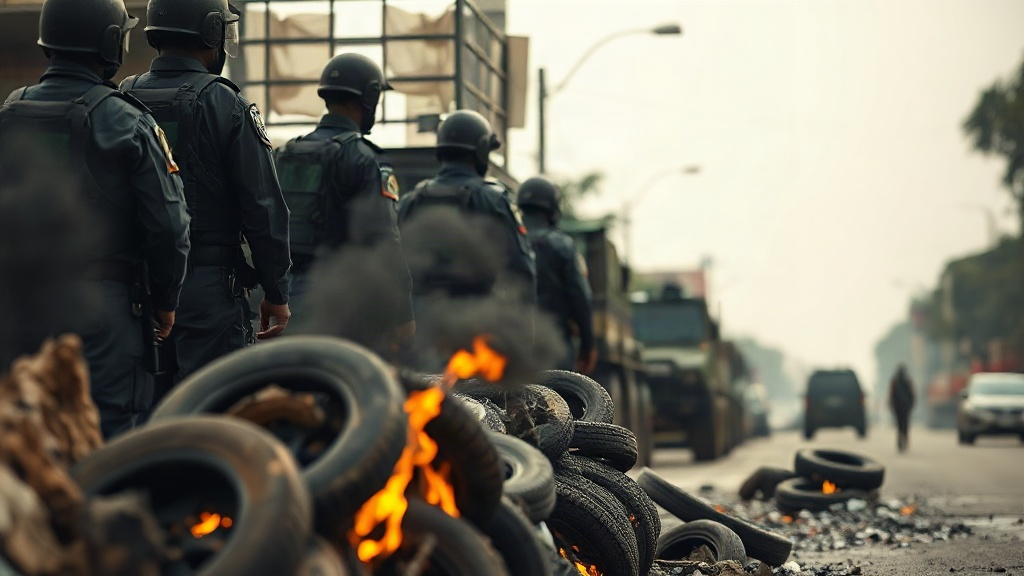
Residents in the Durban CBD, in Soweto and in Johannesburg took to the streets this week over undocumented immigration, and by the time the National Joint Operational and Intelligence Structure briefed the country, 30 people had been arrested. Twenty-five of those arrests were in KwaZulu-Natal and five in Gauteng, according to NATJOINTS, for offences including public violence, illegal gathering, obstruction and resisting arrest.
Those are the numbers. The reason people were on the street is the part that has to be said out loud, because it is the part that will still be there when the deployments are scaled down. South Africans in these areas have been saying for years that the pressure on clinics, on classrooms, on housing lists and on informal trading sites has grown past what their neighbourhoods can carry, and that the enforcement they were promised has not arrived at the scale they were told it would. That is the demand that produced the marches. It is a legitimate position to hold and to put to the state, and it does not become less legitimate because a briefing room is uncomfortable with it.
The state’s answer, as delivered, is that heightened police deployments will remain in place at hotspots in Durban and Johannesburg. That is a policing answer to a question that is also about Home Affairs processing, about documentation, about who is permitted to remain and who is not, and about how quickly any of that can be established. A visible police presence can hold a street. It cannot shorten a Home Affairs queue, and it cannot tell a clinic or a school what to do when the numbers in front of it keep rising.
As SABC News reported on 10 October, NATJOINTS said criminality will not be tolerated and that the deployments will stay. That reporting is accurate on what it covers, and the arrests and the charges are correctly stated. What a South African reader needs alongside it is the distinction between the two things being conflated. A crowd of residents demanding enforcement is not the same event as a criminal act committed in the same street on the same day, and the state has an obligation to keep those apart in how it responds, in how it charges, and in how it describes what happened.
That distinction matters practically. Public violence and illegal gathering are serious counts, and where they are laid the state should be able to say, for each person charged, what that person is alleged to have done. The country has seen what happens when that is left vague: the charge sheet becomes the story, the reason people marched disappears from the record, and the next round of anger arrives with no institutional memory attached to it.
There is also a capacity question the briefing does not settle. Thirty arrests across two provinces is a small number against a national dispute about documentation and enforcement. If the state’s enforcement arm is being asked to carry a policy problem that belongs to Home Affairs, the deployment will hold the line for a week and the underlying argument will be back. South Africans watching this will judge the response on whether the queues move, whether documentation is actually checked and processed, and whether the people who broke the law, whoever they are, face the same process.
What the country is owed now is specificity. Which hotspots, under whose command, for how long, and to what stated end. Which of the 30 arrested are alleged to have committed a violent act and which are alleged to have been part of an unlawful gathering, and on what evidence. And what Home Affairs is doing in the same period, in the same areas, so that the enforcement residents are demanding is not reduced to a police van parked at an intersection.
The Enquirer has put those questions to NATJOINTS and to the Department of Home Affairs. We will publish the answers as they come, alongside what residents in Durban, Soweto and Johannesburg say they are still waiting for.