Tshwane water crisis: 430 sick, city faces culpable homicide charges if a child dies
Finance Minister Enoch Godongwana cut the growth forecast to 1.2% and announced fuel levy relief, while a water expert told eNCA that Tshwane officials should have known the water was unsafe.
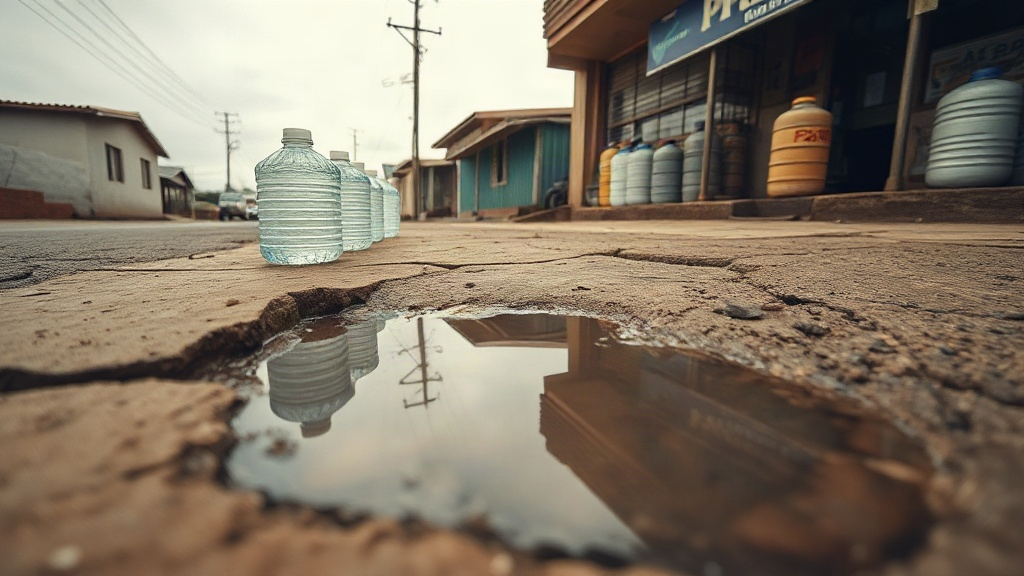
Tshwane could face culpable homicide charges if any of the 430 people, mostly young children, who fell ill after drinking contaminated water in Bronco SPRAY dies, according to reporting by eNCA (YouTube).
The city has confirmed this week that it has resumed adding chlorine to the water, but warns that the product is still not safe for consumption. A Department of Water and Sanitation investigation found that unchlorinated water had been delivered to communities there for three weeks.
Water expert Mike Müller told eNCA that staff at the plant appear to have reported a problem, but that what reached the official site and what residents were told was only that the water was a bit turbid, a bit dirty. Residents were not told it was unsafe. Müller said senior officials in Tshwane should have known because the report went into an information system they all have access to.
“I think there’s going to be a bit of digging to find out who did what and who forgot to do what and who deliberately covered up,” he said. “And if we can show that there’s a deliberate cover up of information about supply failure, I think there will be a very strong case, a criminal case for negligence. And if any child dies, that will turn into a case of culpable homicide because it’s absolutely predictable.”
Müller said that with 400 children suffering diarrhoea, the risk to a weak child is real, and that a death would be unforgivable.
The crisis has put municipal governance back under scrutiny. Local governance expert Paul Berkowitz told eNCA that interventions and Auditor-General reports have not worked because there is no consequence management. “There is no punishment or result for doing a bad job. Nobody gets removed from their post or censured if they’re a public servant,” he said. He pointed to coalition partners across metros refusing to take responsibility for failures, and cited widespread wastage, maladministration and corruption. He said Buffalo City is reported to be losing more than R10 million a month on employee overtime, and that coalition partners in Johannesburg have divided up contracts and tenders.
In Tshwane, Berkowitz said the city was told the price of chlorine for water treatment plants had risen by 400% because of the US-Israel war on Iran, but that there was also a communication breakdown at the plant. He noted the mayor is from ActionSA, the largest coalition partner is the ANC and the head of the municipal public accounts committee is from the EFF, and that water quality and colour problems predate the current administration. “Everyone is pointing fingers at each other. No one wants to take responsibility,” he said.
University of the Free State’s Harlen Cloete told eNCA that local government’s problems are never one thing, and that finance is one of them. He said the Auditor-General’s message to the new administration is to tighten controls, and that the minister should address the funding model. He said the constitutional demands on local government account for more than 46% of the total, yet local government receives about 10% of the equitable share. “We need a new funding model for local government because this one-size-fits-all simply doesn’t work,” he said.
Separately, the University of Fort Hare has reported an outbreak of stomach-related illnesses at its Alice campus in the Eastern Cape. More than 100 students have been affected. The institution says it is monitoring cases, affected students are receiving medical attention, and urgent water quality testing has started at its residences.
In Parliament, Finance Minister Enoch Godongwana presented the medium-term budget and cut the country’s growth forecast to 1.2% for this year, down from the 1.6% projected in February. He said growth is expected to reach 1.6% in 2027 and 2% by 2029. Inflation is expected to come in at 4.4% this year and to return to 3% by 2029.
Godongwana said fiscal discipline and a lower inflation target are helping to contain borrowing costs and reduce South Africa’s risk premium, and that the rand has strengthened and become less volatile. “But growth remains too low,” he said. Government is betting on structural reforms, stronger state capacity and infrastructure investment to accelerate growth.
He said the years of state capture, Covid-19, low growth and rising expenditure and debt brought the country to the brink of a fiscal crisis, and that government had limited bailouts of state-owned entities and prioritised investment over unsustainable consumption. “Today that commitment is beginning to pay off,” he said.
On fuel, Godongwana announced temporary relief. The fuel levy will be reduced by R3 per litre for diesel and R1.50 per litre for petrol in December. The relief will continue at a lower amount until 5 January 2027, with the diesel levy reduced by R1.50 per litre and the petrol levy by R1 per litre. He said the measures provide R10 billion in support at a fiscal cost of R10 billion in foregone revenue, and that the R10 billion transferred to the Central Energy Fund will be returned to the National Revenue Fund.
Elsewhere, the Mdlunga Commission has reserved judgment on whether intelligence official Nandazo Sifo can testify behind closed doors. He is the acting coordinator of the National Intelligence Coordinating Committee, and the documents in question concern allegations that syndicates have infiltrated the criminal justice system. Evidence leader Matthew Chaskalson said the commission does not have the authority to override a decision on classified information. Commission chair Justice Madlanga said Sifo should be given a chance to explain.
Storm damage at the historic Regina Mundi Church and a nearby school in Soweto has highlighted how vulnerable communities are to extreme weather, as SADC meets in Johannesburg this week to prepare for the El Niño season. The SA Council of Churches says building climate resilience is critical to protect lives and regional food security.
In Mpumalanga, three suspects have been arrested for possession of dagga and alleged bribery. Police seized more than 1.5 tons of dagga with an estimated value of R12 million on the N4 near Komatipoort in Middelburg. Officers stopped a speeding truck during patrols on Monday and found 55 bags of compressed dagga. Two men then allegedly pulled up in a Polo and offered police more than R12,000 to release the dagga and the truck driver, and allegedly raised the offer by another R10,000 when officers refused. They are expected to appear in the Middelburg Magistrate’s Court.
In KwaZulu-Natal, a 65-year-old woman has died after a shark attack near Orient Beach. Retired radiographer Janine Loenberg was swimming with a group at around 8am when the shark attacked. Fellow swimmers tried to pull her to shore and revive her, but paramedics declared her dead at the scene. Buffalo City Metro officials have closed Orient Beach and nearby Eastern Beach.
On the sports front, the Proteas declared on 425 and dismissed Australia for 99 on day four of the second Test in Cairns, forcing the follow-on with a lead of 326. Marco Jansen took five wickets, and captain Temba Bavuma made 179.
- PRASA puts 17 new long-distance buses on the road, first fleet buy since 2010 2026-10-15
- Ekurhuleni wins 2400MW power deal, and residents could see bills cut by up to 31% 2026-10-19
- 408 sick in Bronkhorstspruit after Tshwane sent out water it never warned residents about 2026-10-19
- Tshwane sent Bronkhorstspruit three weeks of unchlorinated water drawn from a sewage-heavy river 2026-10-20
- Tshwane taps ran three weeks without chlorine, and 408 people fell ill, most of them under four 2026-10-21
- 408 sick in Bronkhorstspruit as Mashatile inspects the water works 2026-10-26