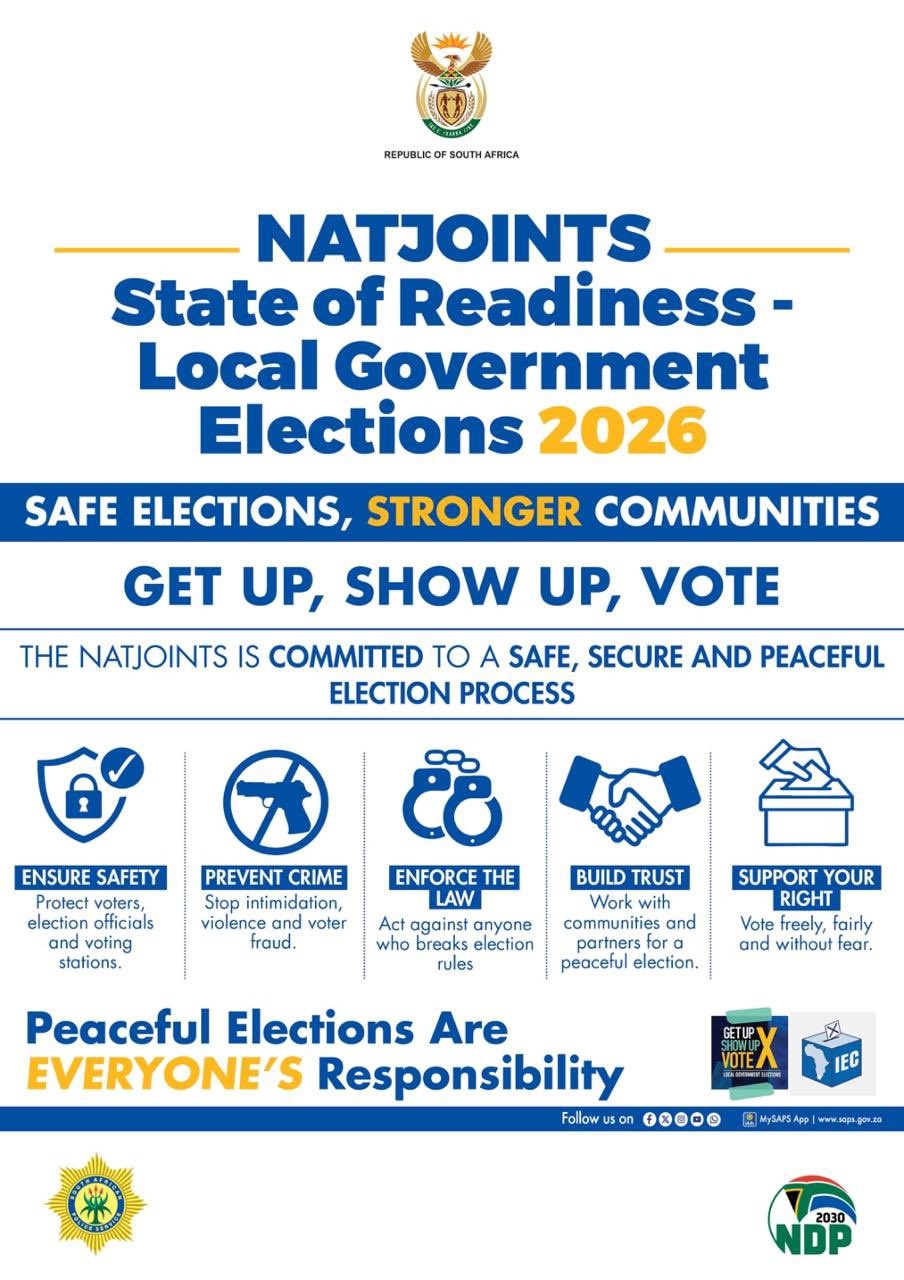
Fake election videos are flooding phones before 4 November, and the IEC wants you to report them
The Electoral Commission has opened its Real411 complaints channel to the public, backed by a new partnership with Google, Meta, Microsoft and TikTok and a gazetted code of conduct for parties and candidates.
South Africans who come across suspicious election content are being asked to report it rather than pass it on, with the Local Government Elections set for 4 November.
The Electoral Commission (IEC) is pointing the public to its Real411 platform, where a complaint can be lodged with supporting evidence at https://real411.org.za/complaints/submit. A Digital Complaints Committee then checks whether the complaint falls within scope, and a sub-committee decides on the appropriate action. That action may include referral to the IEC, the police, the South African Human Rights Commission, the Press Ombud or the Electoral Court. The complainant is told the outcome and guided on how to appeal.
Where a complainant disagrees with the decision of the Real411 Digital Complaints Committee, an appeal can be lodged in writing with the Secretariat, listing the complaint ID and the reasons, at secretariat@real411.org.za.
The Commission’s message to voters is blunt. “Don’t be the one who spreads it. If you’ve reported something and it’s confirmed as disinformation, share that outcome with the people you shared the original post with. Correcting the record matters as much as catching the lie,” it said on its website.
It is also recruiting. Becoming a Real411 Rover Spotter, the Commission says, means joining a community of digital detectives who help keep South Africa’s online spaces safe by spotting fake news, dodgy posts, hate speech and disinformation, and helping fact-check the truth.
The public channel is one line of a wider defensive structure the IEC has assembled ahead of the polls. Earlier in October, the Commission, alongside state research institutions, civil society and global technology firms, set up what it describes as a multi-pronged front against online manipulation, deceptive synthetic media and coordinated campaign interference.
At the centre of that is a partnership with Google, Meta, Microsoft and TikTok, and with the non-profit Moxii Africa, previously known as Media Monitoring Africa. The IEC’s Chief Electoral Officer, Sy Mamabolo, said the Commission is building on lessons from previous national polls.
“Our partnership with digital platforms is critical to ensuring that voters have access to credible, accurate and trustworthy information to make informed political choices. A technically flawless election can still lose public trust if citizens are overwhelmed by disinformation,” Mamabolo said. “Therefore, the partnership eliminates barriers to direct access to the platforms and enables instantaneous remedial action against disinformation peddlers.”
The arrangement follows a similar framework signed with the platforms ahead of the 2024 National and Provincial Elections.
In September the Commission gazetted the Electoral Code of Conduct Countering Disinformation in the Local Government Elections. The code applies directly to political parties and candidates and carries enforcement sanctions for violations.
The technology partners are running their own measures alongside it, using in-app tools, official labels and fact-checking networks to point voters towards authoritative resources.
Microsoft South Africa’s Director of Government Affairs, Abongile Vanda, said trust is the foundation. “Free, fair and credible elections depend on people being able to trust the information they see. No single organisation can tackle disinformation alone, which is why Microsoft is pleased to join the Electoral Commission in this partnership,” Vanda said. Ahead of the 2026 elections, he said, the company will work with the Commission, civil society and industry to help voters find authoritative election information, strengthen media and AI literacy, and counter deceptive AI-generated content.
TikTok’s Government Relations and Public Policy Lead for Southern Africa, Tholoana Ncheke-Mahlaela, said the platform takes its responsibility to protect its community during elections seriously, and that South Africans will be able to reach reliable election information through its in-app Election Centre.
William Bird, Director of Moxii Africa, described credible information as “fundamental to the credibility of any democratic process”. “In an increasingly complex digital environment, protecting voters from misinformation and disinformation requires coordinated action across institutions, technology platforms, civil society and citizens themselves,” he said.
The Council for Scientific and Industrial Research (CSIR) is working on the technical side, and its researchers have warned that generative AI has “industrialised” the creation of fake media, flooding public networks with synthetic video, voice clones and emotionally charged narratives designed to manipulate voters.
“You do not know what is real and what is AI-generated. If we, as researchers, experience this fatigue when analysing information and data, can you imagine what ordinary South Africans are experiencing when they are overwhelmed with information and are uncertain about what is real or fake?” the CSIR’s Avi Moodley said during a recent webinar.
Moodley said the challenge is enormous, and that data, infrastructure, resources and funding can all make a significant difference to coordinated efforts. The council has developed projects including the Informed Fake News Advisor and an information triage system that helps prioritise content for further assessment. Neither is intended for everyday use by ordinary South Africans. They are built for fact-checkers working through large volumes of material on the front lines.
The CSIR’s reporting technologies are still being tested. Moodley said the council is looking at using the coming elections to test some of them, so that capabilities are strengthened as the country moves from the local government elections towards the next national elections.
The elections take place on 4 November. Complaints about election-related content can be lodged at https://real411.org.za/complaints/submit, and appeals against Real411 decisions go in writing to secretariat@real411.org.za.
This report is based on SAnews (South African Government News Agency) reporting of the Commission’s announcements, at https://www.sanews.gov.za/south-africa/lge-2026-be-shield-against-misinformation. The underlying code of conduct and partnership agreements are the primary records.