IEC opens 3,4 million Western Cape voters to special vote applications from 21 September
The province's electoral officer says readiness for the 4 November municipal polls is on track, with 1 623 voting districts and 544 voting centres in place.
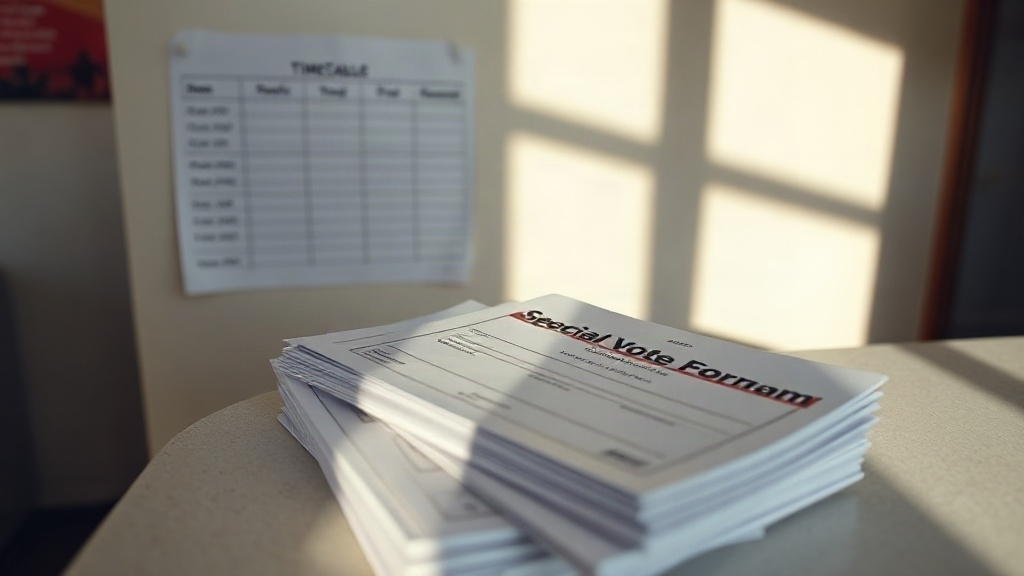
Special vote applications for the Western Cape’s 4 November municipal elections open on 21 September and close at 5pm on 12 October, the province’s electoral officer said this week.
Michael Hendrickse set out the timetable at a multi-stakeholder engagement at the Southern Sun Hotel in Newlands on Tuesday, where the Independent Electoral Commission brought together Chapter 9 institutions, faith-based structures, civil society organisations and representatives of the youth and disability sectors. As IOL reported on 15 September, the commission used the meeting to outline its readiness for the polls.
The province has 1 623 voting districts for the election and its voting centres have grown from 493 to 544. Some 3 456 591 voters are expected to cast a ballot.
What voters will find at the station
Where a voter lives decides what is in their hand at the ballot box. Cape Metro voters receive two ballots. Voters outside the metro receive three, being a ward ballot, a proportional representation ballot for the local council, and a proportional representation ballot for the voter-elected portion of the district council.
Ward ballots will be printed alphabetically. The order in which the proportional representation lists appear will be set out at a briefing the commission will hold in Johannesburg later this month.
“The elections will be tightly run as the Western Cape only has 868 proportional (PR) and ward seats across all municipalities,” Hendrickse said.
A voter may only vote in the voting district where they are registered. That rule, applied on the day, is the single most common reason a person is turned away at a municipal election, and it is the reason the commission is pushing applications and address checks now rather than in the last week of October.
The special vote, explained
A special vote exists for registered voters who cannot reach a voting station on 4 November. Applications open on 21 September and close at 5pm on 12 October. A voter can apply online, collect a form from an IEC office, or send an SMS.
Those who miss the cut-off can still apply in person at their registered voting station on 2 and 3 November.
Voters who cannot leave home because of physical infirmity or disability may apply for a home visit. Those visits run between 8am and 5pm on 2 and 3 November. The commission does not take appointments or set times for them. When an official conducts a home visit, party agents and a police escort travel with them.
The identification requirement does not change for any of this. A green barcoded ID book, a smart ID card or a temporary ID certificate must be in hand.
“It’s a criminal offence to lie about physical infirmity or disability or to submit an application on behalf of someone without their consent,” Hendrickse said.
That warning matters in a province where the special vote roll is routinely contested by parties, and where a fraudulent application is a prosecutable offence rather than a paperwork problem.
Counting, and the close of voting
Voting and counting happen at the voting station. Result slips then travel to the local IEC office for vetting, after which the figures are captured, saved and printed. The system is audited against the original slips before results are filed. Where something untoward is reported, an exception check runs before any result is released.
Voting stations close at 9pm. A voter already in the queue at that hour will still vote, and the commission will identify the last person in the line. Nobody may join the queue after 9pm.
Where the friction is expected
Geoff Mamputa, the commission’s conflict management co-ordinator, named Mfuleni, Delft, the Cape Flats, Du Noon and Strand as areas of concern. The approach there is preventative rather than reactive, with the commission working alongside communities, the South African Police Service and other law enforcement agencies to keep voting stations open and counting undisturbed.
That is the part of the plan that will be tested under pressure. The commission has run municipal elections through contested areas before, and the measure of this one is whether the queue moves and the count is credible on the night.
Two dates to hold
The commission will release the full list of candidates on Wednesday.
It has also confirmed that the Department of Home Affairs will open on 4 November, which has been declared a public holiday, for voters who need to collect an ID or obtain a temporary ID certificate. For anyone whose documents are still outstanding, that is the difference between voting and watching.
Source: IOL, IEC outlines Western Cape readiness for 2026 municipal elections
- Port Shepstone court grants R50 000 bail in Hawks cocaine theft case 2026-09-14
- Meek trial resumes at Johannesburg High Court as state calls more witnesses 2026-09-14
- Five shot at Booysens Magistrates' Court, two dead 2026-09-14
- Solar Industries bids R21.8bn for Omnia at R134.50 a share 2026-09-14
- Mbalula and Dlamini-Zuma meet in Johannesburg High Court over vote-buying claims 2026-09-15
- Kekana medical records fight opens week two of Matlala trial-within-a-trial 2026-09-16
- Johannesburg court voids July 2014 will of 94-year-old businessman as dementia evidence holds 2026-09-18