IEC explains how local council seats are shared between wards and proportional representation
The Electoral Commission has set out how the two voting systems combine to determine final seat allocations in the 2026 local government elections.
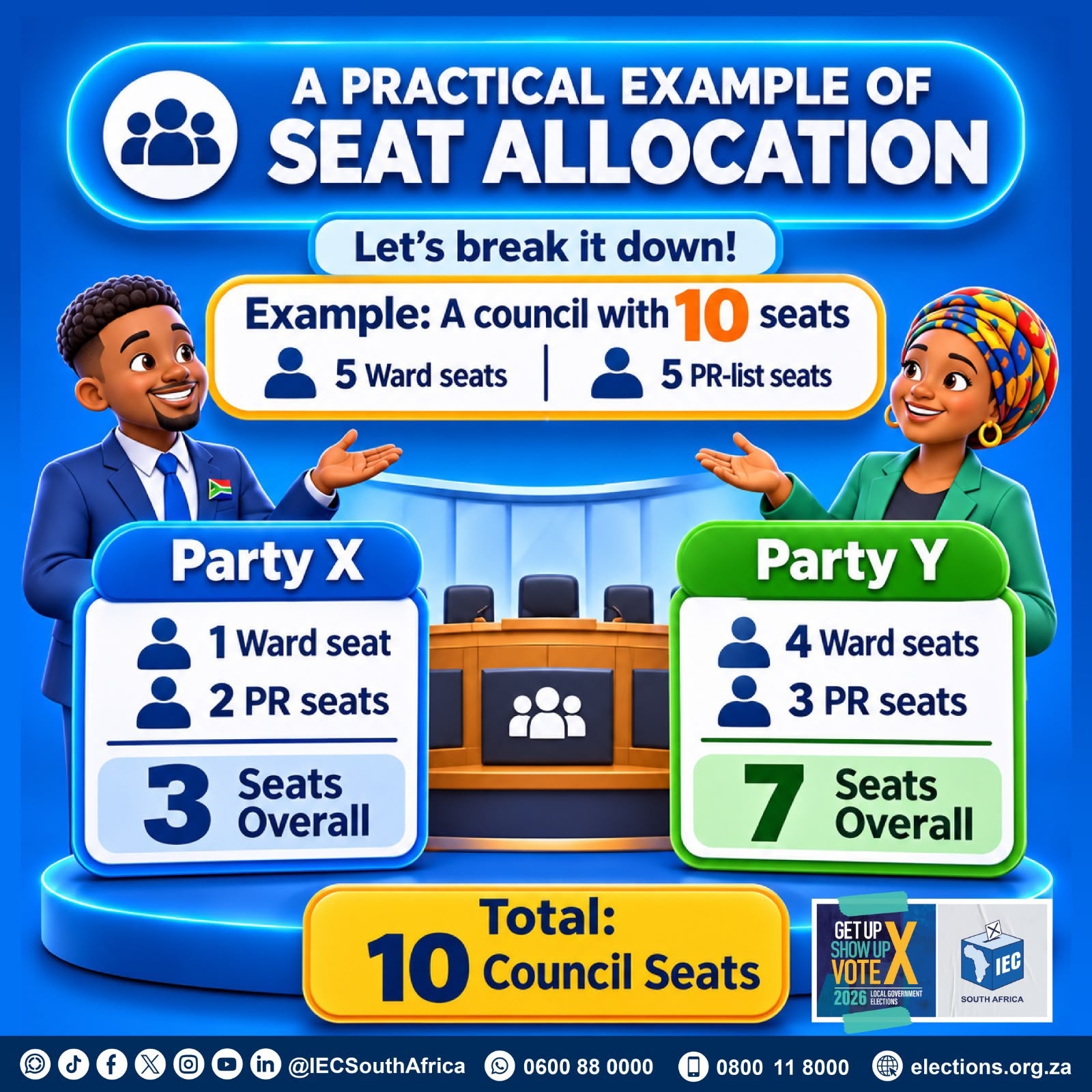
The Electoral Commission has explained how seats are allocated in local government councils, showing how ward results and proportional representation votes combine to determine the final makeup of a council.
In a post on its official X account on 17 November, the IEC provided a worked example of a 10-seat council made up of five ward seats and five proportional representation (PR) seats.
In the illustration, Party X wins three seats in total: one ward seat and two PR seats. Party Y wins seven seats: four wards and three PR seats.
The IEC said both systems combine to reflect voter support.
The post used the hashtag #LGE2026.
- IEC explains how seat allocation shapes municipal power after local elections 2026-11-25
- IEC says trained officers delivered good voter experience 2026-11-25
- IEC says 92% of election staff paid as thousands still wait for money 2026-11-25
- IEC explains the difference between ward and PR councillors after local elections 2026-11-25
- New councils must convene by 27 November, IEC says 2026-11-26
- IEC publishes political party funding declarations for second quarter 2026-11-29