Brazil's Catholic pilgrims walk 240km as election fight splits the vote
Lula and Flavio Bolsonaro court Catholic and evangelical voters in a runoff where religion has taken over the closing stretch.
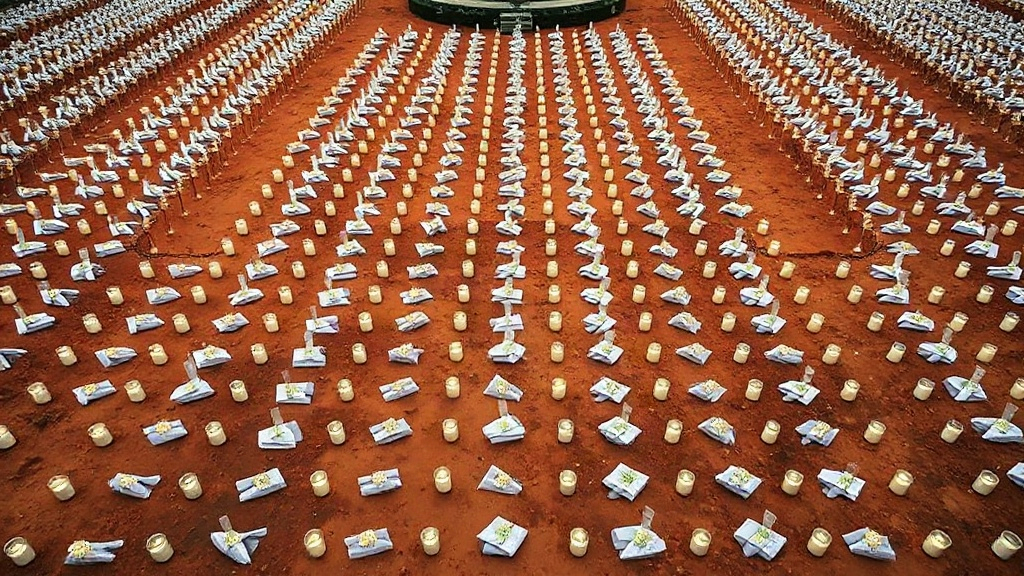
Thousands of pilgrims gathered at the largest shrine to Our Lady of Aparecida on Monday for the feast day of Brazil’s patron saint, as the battle for the Catholic vote moved to the centre of a presidential runoff campaign.
President Luiz Inacio Lula da Silva and Senator Flavio Bolsonaro meet in an October 25 runoff. Religion has dominated the final stretch of the campaign in a country where Catholics remain a majority at 57 percent of the population, but are declining as the evangelical community grows, now at 27 percent according to the latest official data from 2022.
As eNCA reported on 13 October, both candidates attended religious services in the saint’s name on Monday and made political remarks from them. Lula said the saint was “offended” by those who “do not respect” the religion of others. Bolsonaro asserted his “respect for the faith of millions of Brazilians.”
Ahead of the first-round vote earlier this month, Bolsonaro fiercely denied a rumour that he planned to demote Our Lady of Aparecida if elected. The saint is revered by Brazil’s Catholics but is not recognised as an object of worship by its evangelical population, a crucial support base for Bolsonarismo, the political project Flavio inherited from his jailed father, former president Jair Bolsonaro.
For the pilgrims who made the journey, the dispute over the title was a distraction. Maria Vanda Lopes, 54, an education student, walked 240 kilometres over seven days from her hometown of Valinhos to Aparecida, leaning on a walking stick. She called the fallout over the saint “absurd.”
“It’s purely a political ploy. No one is going to strip her of the title,” she told AFP. She said she will vote for Bolsonaro. “I’m a woman, but I’m not a feminist. I’m traditional. I’m on the right.”
Another pilgrim, 29-year-old student Amanda Rosa Alves dos Santos, travelled from the southeastern city of Vicosa and plans to vote for Lula. She said Brazil is a “secular state” but that with Flavio Bolsonaro “we feel insecure about the Catholic faith.”
Polls show Lula enjoys strong support from Catholic voters. The Catholic Church has tried to calm fears over the patron saint’s status, which was granted by the pope in 1930. “Of course we wonder what might happen depending on the results of the second round, but this is not the time to imagine scenarios that might frighten us,” said Mario Antonio da Silva, the archbishop of Aparecida.
Not every pilgrim framed the moment as a contest. David de Santos, a 47-year-old chainsaw operator who walked 50 kilometres in 24 hours to reach the shrine, said it was important not to mix politics with religion, and praised the harmony he saw between Catholics and evangelicals. Along the way, he said, he met evangelicals handing out water, fruit and medicine to pilgrims.
Pastor Gustavo Knauer described the coexistence between the two faiths as “perfectly normal,” pointing to the Bolsonaro family itself, where Jair is Catholic and Flavio is not.
Rodrigo Nunes, a professor at Rio de Janeiro’s Pontifical Catholic University, described evangelicalism’s conservative rhetoric as “a magnetic force,” and said issues around gender have resonated across the spectrum, leading to “a shift of Catholic votes toward the right.”
Bolsonaro is the favourite to win the runoff, having taken 47 percent of votes in the first round against 45 percent for Lula. The first-round result and the polling on Catholic support point in different directions, and the October 25 vote will settle which bloc turns out.
For South African readers, the Brazilian runoff is a reminder of how quickly a religious constituency can become an election’s decisive bloc. Brazil’s census data shows the same drift that has reshaped politics across Latin America and parts of Africa, where established churches lose ground to faster-growing evangelical movements that organise at congregational level and vote as a bloc. South Africa’s own religious landscape is similarly mixed, with mainline churches, independent African-initiated churches and a fast-growing Pentecostal sector, though no South African election has turned on a single denomination’s turnout in the way this Brazilian runoff has.
What the Brazilian case shows is narrower and more useful than a comparison of faiths. A candidate’s standing with one religious group can be moved by a rumour about a saint, denied at speed, and answered from a pulpit within days. The pilgrims at Aparecida walked for a week to be there. Whether that devotion translates into votes for either man is the question the runoff will answer on 25 October.